But this is not the first time the Internet, online Role-playing Games [RPGS], or World of Warcraft [WoW] has had the finger pointed at them for tragic events. American Culture has devoted a large portion of its news media, and a whole television program [Dateline: To Catch A Predator] to the reporting of crimes that take place over the Internet. In December of 2005, Blizzard Entertainment, the company behind World of Warcraft, was blamed for the suicide of a young Chinese boy. It was reported in TGdaily, a copyright of Tiger Vision Media, “The boy, who played a Night Elf in the game, believed that he could meet his favorite Night Elf hero, if he committed suicide.” In the case of Trenor, It was told by the father of the late Riley Ann “"Kim got hooked on it. She'd be on it three, four hours, be on it until one in the morning."
World of Warcraft is, perhaps, one of the greatest achievements of the Blizzard Entertainment Company (Owned by Vivendi Games), which just recently announced plans to merge with another popular gaming company, Activision; creators of the popular Guitar Hero Franchise. Blizzard’s company profile stated the following:
“World of Warcraft initially launched on November 23, 2004 in North America, Australia, and New Zealand, with subsequent launches in South Korea, Europe, mainland China, Singapore, and the regions of Taiwan, Hong Kong, and Macau in 2005, Malaysia in 2006, and Thailand in 2007. The game has achieved unprecedented popularity on a global scale, with currently more than 9 million subscribers worldwide. It is available in seven different languages based on the regions in which it is played, and has earned awards and praise from publications around the world.”
According to research done in 2005 by Nick Yee, researcher of "The Daedalus Project" whose extensive study in the field has been quoted by the Associated Press and the Washington Post, 84% of World of Warcraft’s players are male, and 16% female. In addition, the average player plays about 22 hours a week.
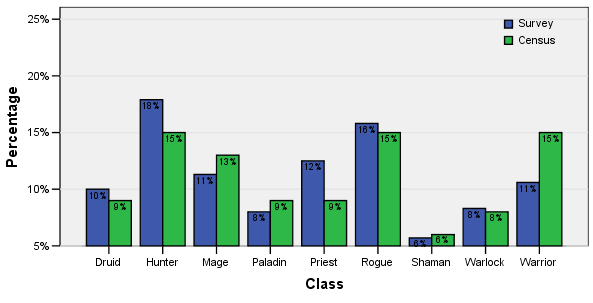
An example of Nick Yee’s research.
These observations collaborate accurately with the testimonies of those willing to speak on their experiences in various online role-playing games. Visiting online social websites, such as Gamer Vision (www.gamervision.com), a website made especially for gamers, yielded some interesting results. Ryan, aged 25 and a web application developer shared his experiences in saying the online world he played in “was very addictive and took many, many hours of my life. I would work 9-5 then come home and play until 2 or 3 in the morning 4 or 5 days a week. This was one of the reasons I stopped. I had no life in the physical world.”
Sarah LeBoeuf, a staff writer for the gaming social website, states the ‘never ending’ qualities of online RPGs as her reason for initial addiction to them. ” There were endless possibilities, and I just wanted to explore more. And to get good enough to go all over the fictional world, I had to level up. It was an endless cycle of leveling and exploring and looting and selling.”
Others, however, assert that while these online worlds are fun, that they were able to successfully maintain their priorities in the real world. “Addiction is a strong word, I don’t think I would have considered myself addicted at any point of my gaming career, I might play a lot but I always put real life first and once all my responsibilities are done for the day then its game time.” Says Jay Lane, a student and network administrator
But what exactly is the appeal of these online virtual worlds, and why are they consistently reported so negatively in today’s media? According to the Aspen Education Group, an organization set up in Utah’s Aspen University
“Teens Want Never-Ending High - WOW and most MMORPG’s are designed to never end. There is no one plot line that some all-knowing creator has contrived. This makes kids never have an in game conclusion that would cause the child to stop playing as they generally would with other standard games. The story line is what the players make it. And, in a teenager’s mind, this means “the universe revolves around me.” This is truly a teenager’s perfect heaven; the perfect high.”
In addition to the everlasting nature of the game, Massive Multiplayer Online RPGs [MMORPGs] often if not always include some method of chatting interface. “The social component alone often gives the teen 'gamer' the desire to play this type of game.” Says Aspen.
Aspen and other institutes have risen in the past few years to study and treat those with supposed 'addictions' to the Internet and Online gaming. Dr. Kimberly Young is the director of one such program called "The Center For Internet Addiction", which was founded in 1995. She is the author of the first book to address Internet addiction Caught in the Net. While the Center of Internet Addiction admitted that addiction to gaming is a fairly new concept, their web site (http://www.netaddiction.com/) still held valuable information. The Center for Internet Addiction states "Online gaming addiction is an addiction to online video games, role-playing games, or any interactive gaming environment available through the Internet. Online games such “EverQuest”, the “World of Warcraft”, the “Dark Age of Camelot”, or “Diablo II” – dubbed "heroinware" by some players – can pose much more complex problems. Extensive chat features give such games a social aspect missing from offline activities, and the collaborative/competitive nature of working with or against other players can make it hard to take a break."
The web site also notes certain symptoms of online gaming addiction "Gamers who become hooked show clear signs of addiction. Like a drug, gamers who play almost every day, play for extended periods of time (over 4 hours), get restless or irritable if they can’t play, and sacrifice other social activities just to game are showing signs of addiction.". Dr. Kimberly Young, however offers a variety of family and individual therapy for children and adults who may suffer from this type of addiction. "In many cases, gamers find acceptance, respect, and recognition through the game, and the online character replaces relationships that are missing in the gamer’s life. She counsels parents dealing with an addicted child reluctant to enter treatment."
Nick Yee of the Daedalus project, however, finds certain flaws in the argument that addictions to these games, and the Internet as a whole is a problem in society. "For any given media form, hobby, or activity, it is probably true that some percentage of people will fall into this criteria of “addiction”. The only difference is that researchers choose only certain activities to investigate for addiction disorders. The Internet is dangerous whereas other activities are wholesome and good. But if any and every activity can have its very own addiction disorder, it’s not clear that such a notion is meaningful. On the other hand, picking and choosing which activities we deem “addictive” seems more and more arbitrary. Another problem is that it conflates all kinds of things that people do online. It were as if any normal activity suddenly becomes potentially deviant and dangerous when it happens online." He states in his blog, that can be found at http://www.nickyee.com/daedalus.
Others believe that online gaming within the world of MMORPGs can lead to some good qualities and positive learning experiences. At Toronto's Future Play 2007 conference, "Dr. Constance Steinkuehler, assistant professor in the Educational Communication & Technology program for the University of Wisconsin-Madison, argued that MMOs and online worlds are good "push technologies" for education, rather than threats to it." reports online gaming news website www.gamasutra.com.
Her presentation, titled "Massively Multiplayer Online Games as an Educational Ethnology: An Outline for Research" listed many positive aspects of the form of gaming so many others like to link to negative social behavior. According to gamasutra , Steinkuehler described first how games such as Lineage encouraged players to preform "orally delivered narratives" to share the lore of the gaming world with their fellow players. This, she argued proved that gaming can actually boost literary skills and creativity. "“If you compare them to things like the national reading standards, many of these practices not only meet the national reading writing and technology standards, they exceed them." , Steinkuehler argued.
Steinkuehler also added World of Warcraft into her study, saying that players who studied the statistical properties of their characters (Also known as 'stats'; number representations of qualities such as Strength, magic power, and armor). After studying the World of Warcraft forums, she concluded that the players thought with "a scientific mind".
"Only eight percent was "banter," she noted -- although six percent was "literally nonsense." A third of the discussion built on other ideas, and a third used counter-arguments. 28 percent used data and evidence to back up their ideas. 12 percent also gave alternative explanation of data, and 7 percent gave references to outside resources." she reported. Also found in the research, according to gamasutra, "discussions about character statistics...were so mathematically complex as to be incomprehensible to the conference attendees, concluding that comprehending the stat-based rules at the core of the average MMO's play system both required and developed advanced skills."
These and other positive testimonies also matched up with those from Gamervision regulars. When asked about the positives of the online games he played, Jay Lane replied "The positive things that happened through my experiences in both games were having fun with my friends, forging new friendships with other gamers that I still game with today, and learning teamwork skills (25 man raids in WoW). I have been a guild officer in both games and this has also allowed me to tone skills in leadership and problem resolution without a doubt."
While tragic events can sometimes occur due to these outlets, that can be said about anything, and one must always remember not to blame an entire culture for the mistakes of a few. In playing these games, one must remember moderation, and take the good along with the bad, while sending hope and good will out to the unfortunate victims of tragedies laced with these social outlets, such as Baby Grace AKA Riley Ann.
Sources:
http://www.tgdaily.com/content/view/21757/118/
http://www.chron.com/disp/story.mpl/front/5345103.html
http://www.blizzard.com/inblizz/profile.shtml
www.gamervision.com (GamerVision Used For Interviews Via subscribers)
[Taken from a post made by me on www.gamervision.com on 12-12-2007 for fufillment of a Research for Journalism class project]


No comments:
Post a Comment